Systems of Record
Contracts, obligations, suppliers, policies, and regulatory data, continuously current in one place.

Leah Procurement, powered by Leah Maestro, is an agentic AI solution that runs the full source-to-pay lifecycle, from intake and sourcing through contracts, purchase orders, and invoice matching. Built on Leah Maestro, its specialized agents take on the tedious work that normally ties up your team, and every agent functions within the policies and risk appetite you define.
Request a DemoYour team already has dashboards, supplier risk tools, contract systems, and ERP platforms. What it lacks is a layer that connects them and acts. Leah Procurement joins three systems most enterprises run separately, then executes the work that moves between them.
Contracts, obligations, suppliers, policies, and regulatory data, continuously current in one place.
Procurement, legal, and commercial reasoning applied to every request, redline, and risk signal.
Workflows, approvals, escalations, and enforcement, with audit trails and human review where it matters.
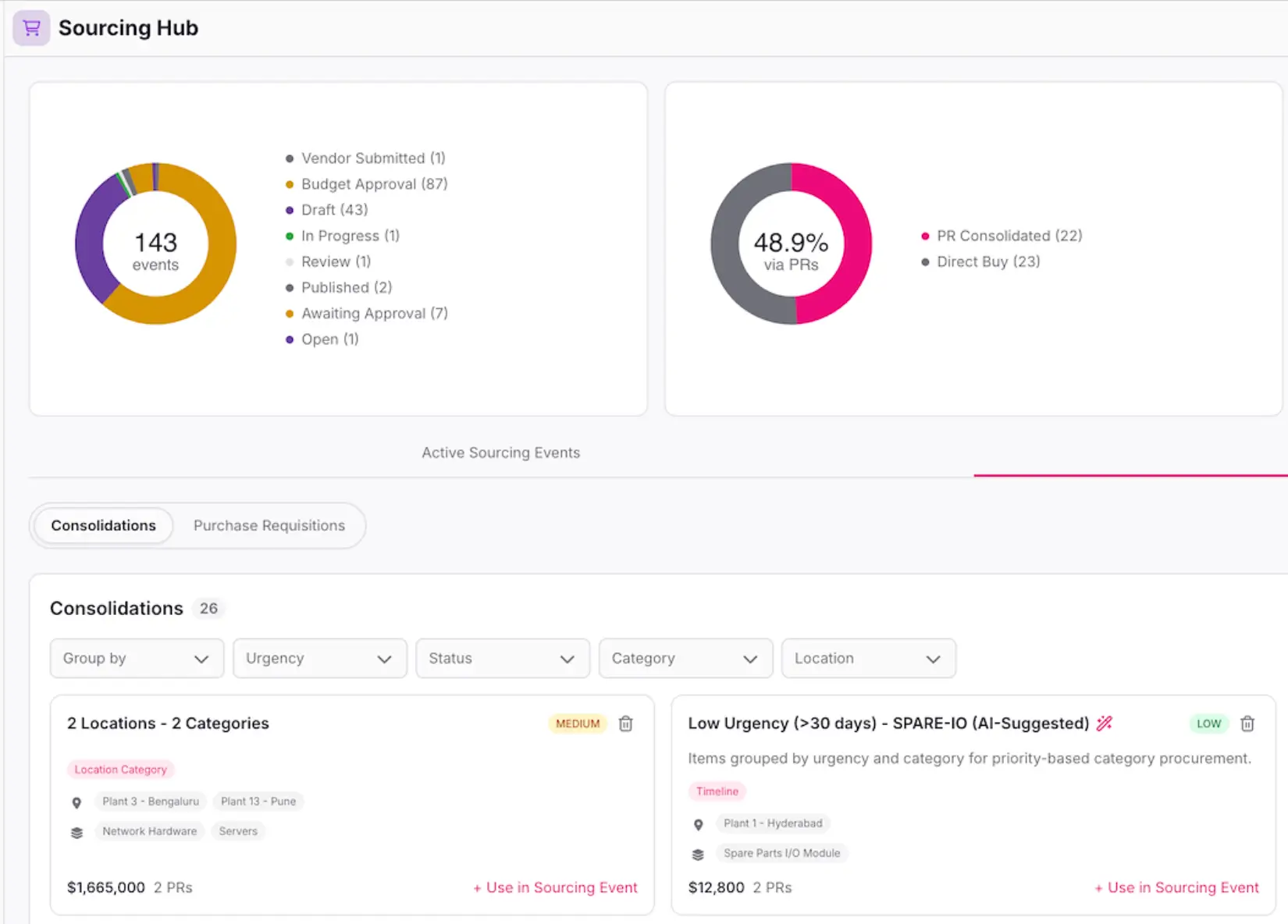
Specialized agents run each stage of the source-to-pay lifecycle, and context flows downstream: risk data informs sourcing, negotiation outcomes feed contracting, and contracted terms drive purchase orders and payment. Follow one request through.
You ask where the money is going. Leah reads every transaction, splits spend by category and vendor, surfaces the concentration that quietly becomes risk, and forecasts the quarter ahead from open commitments and invoice history. No dashboard to build, no analyst to brief, and no exposure left hiding in a spreadsheet.
A strategy-aligned RFx is drafted from approved clauses and category intent. Qualified suppliers are shortlisted, responses are scored on predefined commercial, technical, and risk dimensions, and the award recommendation arrives with an auditable rationale.
The selected vendor is onboarded in days, not weeks: documentation, validation, and approvals run automatically, and financial, regulatory, ESG, and operational risk is assessed in a single pass. Monitoring then never stops, so risk that emerges later surfaces before it becomes disruption.
Before talks begin, Leah builds target pricing from market benchmarks, supplier behavior, and historical outcomes, and simulates the scenarios that matter. Rounds can run autonomously within the guardrails you set, escalating to the buyer only when thresholds are crossed.
The contract is drafted from approved templates and redlined against your risk tolerance and past outcomes. Legal reviews the exceptions, not the whole document, and once signed, obligations are tracked and enforced so value does not leak after execution.
The purchase order is generated from the contract, not typed from scratch. Invoices are matched continuously against the purchase order, goods receipt, and agreed terms, so discrepancies, overcharges, and leakage surface with evidence before payment goes out.
Each module syncs live from your ERP, runs reconciliation intelligence on top of it, answers questions against the data in plain language, and turns it into interactive charts that give buyers, finance, and vendors instant answers.
Invoices sync from ERP and reconcile against POs, GRNs, and contract terms, so discrepancies, overcharges, and leakage surface with evidence before payment.
Goods receipt data syncs from ERP and is matched against orders and deliveries, giving a live, reconciled view of what was ordered versus what actually arrived.
Payment status syncs from ERP and is reconciled against invoices and terms, giving internal teams and vendors a single, real-time view of what has been paid and what is outstanding.
The lifecycle runs the work. These run the whole time, so a buyer three stages deep has answers, risk cover, and a defensible record without asking for them.
Always-on guidance for every buyer. Clarifies RFx questions, explains contract terms, and answers real-time queries across invoices, purchase orders, and goods receipts, so no one waits for an expert to free up.
Supplier risk never goes dark. Financial, sanctions, ESG, and operational signals are re-evaluated as they change, and emerging issues surface before they become disruptions, audits, or headlines.
Every decision on the record, with the evidence behind it. Actions are logged identically whether a person triggered them, an agent did, or another system called in through an open endpoint.
Payment-only tools start every purchase order and invoice match from scratch. Leah's sourcing and contracting foundation means the data downstream execution needs already exists and is already trusted.
Watch a single purchase request move from plain-language intake to a scored RFx, a redlined contract, and a matched invoice, with policy enforced at every step and every action on the record. That's your entire procurement cycle, orchestrated.
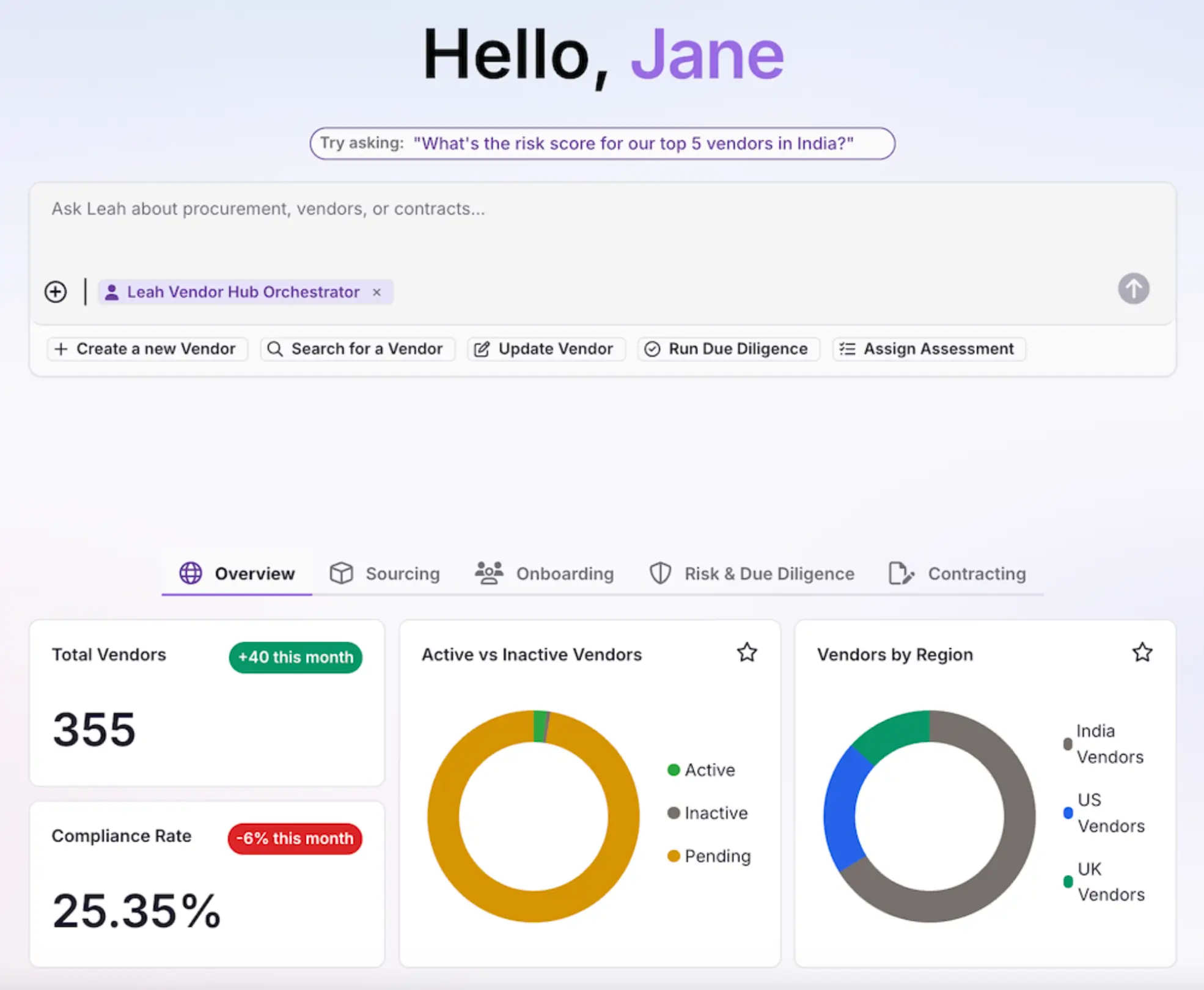
The agent library is the starting lineup. Ask Leah puts the whole platform behind a single chat window, Leah Studio lets your team build its own agents, and open interfaces let the rest of your enterprise put Leah to work.
Run procurement from a chat window.
Query and act across the full lifecycle without leaving the conversation: onboarding, due diligence, risk scores, sourcing, and contracts. When a question returns structured data, Leah builds a dashboard inline, on the spot.
Build your own agents. No code required.
A visual workflow designer with conditional logic, role-based approvals, and policy-governed automation. Configure agents, actions, and workflows specific to your commercial processes, without engineering overhead.
Put Leah to work from your other systems.
Enterprise systems can trigger onboarding, move workflows, pull risk scores, and run assessments through open endpoints, authenticated and governed by the same role-based controls as every user action.
"Introducing Leah to the procurement team is one of the most successful things we've done."
Lidia KamlehChief Legal Officer, Dubai Future Foundation
Leah Procurement is built for regulated enterprise environments, with enterprise-grade AI governance and human-in-the-loop controls your team configures.
Approvals, reviews, and decision points are embedded in every workflow, with configurable thresholds and escalation paths per agent.
A full audit trail covers every decision, whether a person triggered it or another system did. Reviewers can override any agent decision.
Role-based permissions run across every module and endpoint, securing sourcing, vendor data, contracts, and financial workflows.
Cloud native and multi-tenant on Microsoft Azure, with strict tenant isolation, data privacy by design, and fallback paths for exceptions.
Leah Procurement layers over the systems you already run, with pre-built connectors across ERP, finance, and risk intelligence. No rip and replace.
SAP Ariba, Workday, NetSuite, Oracle, Jaggaer, Ivalua
Salesforce, Microsoft Dynamics
DocuSign, Adobe Sign, Viafirma
Dun & Bradstreet, EcoVadis, Dow Jones, S&P, Moody's, plus market, news, and regulatory feeds
Contract, supplier, and document management, plus BI and analytics platforms
REST APIs, webhooks, and open endpoints for two-way exchange with internal and proprietary systems
Agentic AI in procurement refers to AI systems that take action rather than just analyze or advise. Unlike copilots that respond to prompts, agents execute multi-step workflows: triggering due diligence, scoring bids, running negotiation rounds, flagging compliance issues, and routing approvals, all within governance guardrails your team sets.
Leah Procurement is an agentic AI platform built on Leah Agentic OS. Specialized agents run the full source-to-pay lifecycle: intake, sourcing, supplier onboarding, risk and due diligence, negotiation, contracting, purchase orders, and invoice matching, in one connected platform. It turns fragmented, manual procurement into an autonomous, policy-driven system.
A copilot responds when you prompt it. Leah acts on your behalf. It monitors spend, consolidates demand, runs sourcing events, manages negotiation rounds, and flags supplier risks without a prompt for every action. Your team supervises outcomes and steps in for exceptions rather than driving every task manually.
Yes. Leah creates and manages purchase orders from approved requisitions, handles change orders and multi-level approvals, and writes back to your ERP. Invoices are matched continuously against purchase orders, goods receipts, and contract terms, so discrepancies surface before payment. Because purchase orders are generated from contracts already in the system, matching starts from terms you agreed, not from scratch.
Yes. Leah has pre-built connectors for SAP Ariba, Workday, NetSuite, Oracle, Jaggaer, and Ivalua, CRM platforms including Salesforce and Microsoft Dynamics, and e-signature tools including DocuSign, Adobe Sign, and Viafirma. Risk intelligence flows in from providers such as Dun & Bradstreet, EcoVadis, Dow Jones, S&P, and Moody's. Open REST APIs and webhooks support custom integration.
AI governance is embedded in every workflow. Leah enforces approved clauses, approval thresholds, and risk policies automatically, routes exceptions to the right stakeholders by role and context, and maintains a full audit trail of every decision, including actions triggered by other systems. Reviewers can override any agent decision, and agents can flag items for human review.
Out-of-the-box agents can be deployed immediately for high-priority workflows such as vendor onboarding, sourcing automation, or contract drafting. Most organizations start with one or two high-friction workflows and expand from there. Leah Studio, the no-code workflow designer, lets your team extend and customize without IT involvement.
Leah is built for enterprise procurement organizations: teams managing significant supplier bases, complex sourcing events, and cross-functional compliance requirements. It is particularly well suited to organizations that have invested in procurement technology but find that disconnected systems, manual workflows, and reactive processes are limiting their impact.
Request a demo and the Leah team will walk through the source-to-pay lifecycle using scenarios from your own procurement operation. From there, most teams deploy one or two out-of-the-box agents against their highest-friction workflows and expand as results land.