
How to use this comparison
Leah and Agiloft are both CLM platforms. A responsible evaluation should compare the workflows, data model, controls, integrations, implementation approach, service model, and evidence that matter to the buying organization. This page does not present either platform as the only provider with AI capabilities or make unverified claims about pricing, accuracy, implementation duration, market segment, language coverage, or customer results.
Agiloft’s current platform materials describe configurable workflows and AI capabilities for contract analysis, review, risk, obligations, and search. Leah’s product information should be evaluated against the organization’s own use cases and requirements. Product capabilities change, so teams should validate them in current documentation and a scoped evaluation.
What Is Leah?
Leah represents the next generation of enterprise contract lifecycle management, utilizing advanced artificial intelligence to transform legal operations through agentic AI and predictive analytics. The platform's core strength lies in its embedded and native AI architecture, where artificial intelligence is built directly into the platform rather than added as a separate layer.
The platform's AI capabilities are designed for simplicity and speed to value. Unlike solutions that require extensive configuration, Leah offers dynamic extraction that's already built-in, enabling organizations to realize results faster. This approach reduces the configuration burden typically associated with AI-powered contract management solutions.
Core Differentiators of Leah
- Agentic AI Architecture: Leah provides advanced AI capabilities that stand out in competitive evaluations, combining sophisticated natural language processing with legal-specific intelligence
- Unified AI Experience: Unlike fragmented approaches that require users to move between separate clause libraries and AI tools, Leah provides a seamless, consistent user experience with all AI functionality integrated natively
- Speed to Value: With features like dynamic extraction already built-in, Leah delivers faster implementation and quicker return on investment compared to platforms requiring extensive setup
- Enterprise-Grade Capabilities: The platform supports complex organizational structures, as demonstrated by recent enterprise wins where it enabled corporate-level oversight across multiple operating companies
- No-Code Design with Lower Configuration Burden: Leah's no-code platform reduces the extensive setup and ongoing fine-tuning required by other platforms, offering out-of-the-box intelligence that delivers meaningful results without heavy administrative overhead or technical expertise requirements
What Is Agiloft?
Agiloft describes a configurable contract lifecycle management platform. Its current public materials describe workflow automation, repository and reporting capabilities, and AI-assisted contract analysis, review, risk, obligation, and search features. Teams should validate the licensed package, configuration, integrations, security requirements, and operating model for their own environment.
Evaluation considerations
- Use representative agreements and workflows.
- Test playbook, approval, extraction, search, obligation, and reporting requirements.
- Review security, data handling, access controls, and integration needs.
- Confirm implementation and support commitments in the applicable agreement.
How Do Leah and Agiloft Compare in Enterprise Capabilities?
The fundamental distinction between Leah and Agiloft lies in their approach to AI integration and deployment philosophy. Leah emphasizes embedded, native AI that provides a unified experience, while Agiloft offers highly configurable AI through separate tools that operate independently.
Comparison framework
| Area | Questions to validate |
|---|---|
| Workflow and governance | Can the team model approvals, playbooks, exceptions, and accountability for its agreements? |
| AI-assisted work | Which review, extraction, drafting, search, and obligation use cases are available in the licensed configuration, and how are outputs reviewed? |
| Data and integrations | How will the platform connect to the systems of record and maintain data quality? |
| Deployment | What implementation, change-management, security, and support work is required? |
Why Choose Leah Over Competitors
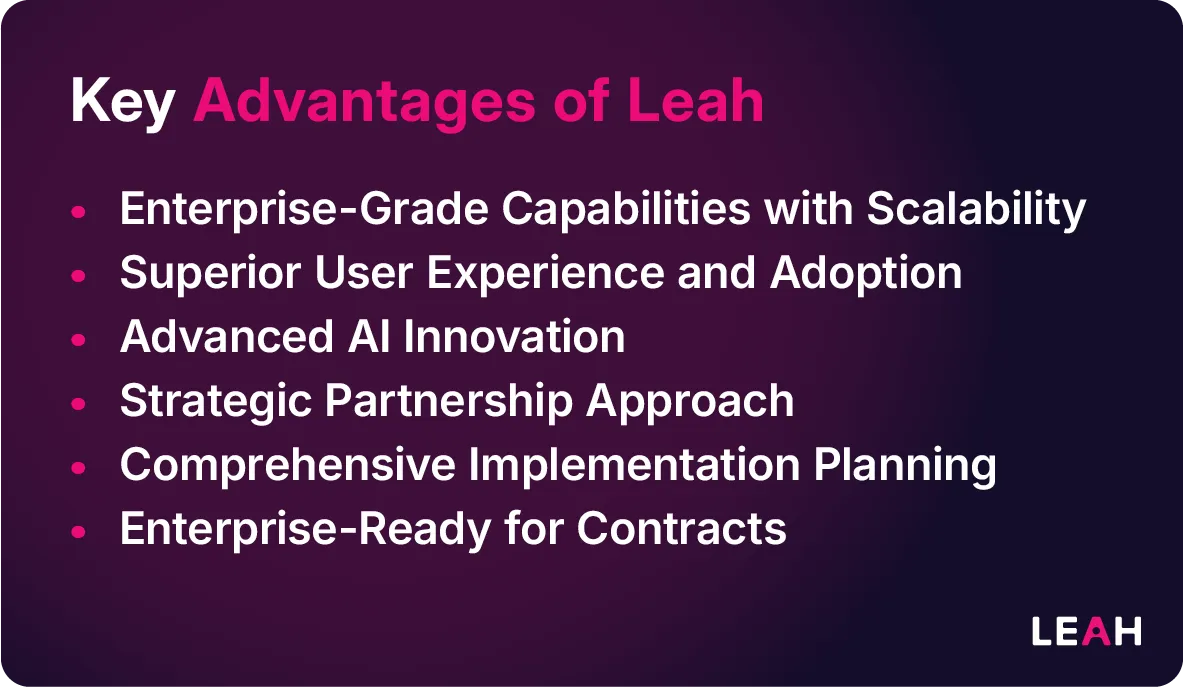
Organizations consistently select Leah for several key advantages that directly address common pain points in contract management:
- Enterprise-Grade Capabilities with Scalability: Customers value Leah's ability to support complex organizational structures while enabling centralized oversight across multiple business units. The platform grows with organizational complexity without compromising performance
- Superior User Experience and Adoption: The user-friendly design facilitates easy adoption across teams, reducing training requirements and accelerating user onboarding compared to more complex alternatives
- Advanced AI Innovation: Leah’s AI capabilities consistently stand out in competitive evaluations, with customers recognizing the AI functionality as significantly ahead of alternative solutions in the market
- Strategic Partnership Approach: Organizations appreciate Leah's consultative methodology, with tailored interactions that align with leadership priorities and establish credibility as a strategic partner rather than just a software vendor
- Comprehensive Implementation Planning: Customers value clear, comprehensive implementation and delivery plans that provide confidence in successful deployment and time-to-value realization
- Enterprise-Ready for Contracts: Purpose-built for contract management with embedded legal frameworks, delivering contextual understanding of clauses, precedents, and regulations without repeated prompts
Implementation and Strategic Investment Considerations
Leah Investment Profile
- Focus: Enterprise-grade native AI with unified experience
- Maintenance: Lower ongoing configuration requirements
- Scalability: Designed for complex organizational structures
Agiloft evaluation questions
- Workflow: Which approvals, playbooks, exceptions, and reporting needs can be configured for the priority agreements?
- AI-assisted work: Which licensed capabilities are available for review, extraction, search, risk, and obligations, and how are outputs reviewed?
- Support: What implementation and support commitments are included in the proposed agreement?
Key Decision Factors
Choose Leah When:
- Organizations prioritize compliance, risk management, and post-signature insights
- Faster deployment and time-to-value are critical
- Unified AI experience and reduced administrative burden are valued
- Enterprise-grade capabilities with global scalability are required
- Industries demand vertical-specific capabilities and intelligent contract analytics
Choose Agiloft When:
- Deep customization and configuration flexibility are paramount
- Organization has dedicated resources for extensive setup and maintenance
- Diverse departmental use cases require highly tailored workflows
- Budget allows for comprehensive partner-led implementation
- Community-driven features and extensive integration ecosystem are valued
Decision process
Use a requirements matrix, representative data, and current vendor documentation. Ask each provider to demonstrate the same priority workflows and to identify any configuration, integration, or governance dependency. The final decision should reflect the organization’s risk tolerance, resourcing, and operating model.